Well what can I say it has been quite a journey! This is far from done, but we have had quite the journey so far. I thought it would be best to go over the highlights of how we reached these milestones.
This started out of frustration of the 8th and 9th style game play. Large amounts of balance disruption, no point formula for balance, and just a general style of play that veteran players were not enjoying or broke the immersion of the table top game. When you spend hours and hours painting and basing your miniatures, then doing the same for the terrain, and the game has large visually unbelievable rules it kills the mental image conjured by the lore.
For starters, I was able to utilize about 500 hours invested in a 6th and 7th edition project I had been working on. The goal was to include other universe empires in both space and ground warfare to see who was most suited to dominate the galaxy if they shared it. With army sizes being to hard to tell on what could be deployed without compromising security, it was easy enough to settle on point balancing. The real challenge would come from if the universes were well rounded enough to be able to rise to a myriad of challenges. As an equal fan of these challenges, I dug deep into the lore and many game systems to find suitable hosts.
Ground battle was determined to be Warhammer 40k. An obvious choice for the 15 way free for all I had planned at 15,000 points per army. Smaller for 40k, but massive for the supply of miniatures available in similar scale. Space battle side of it had Halo Fleet Battles selected. The ships were impossible to scale to each other, so that made acquiring models easier, and the system was very open ended and made for easy transitions.
Upon reverse engineering both systems for point costs, I introduced Star Wars (Republic, Separatist, The Empire, and the Rebellion), Star Trek (The Federation, Klingon Empire, Romulan Empire, and the Borg Collective), and Halo (The UNSC, Covenant, and the Flood). For 40k I selected four armies based off my collection and feeling of extreme dominance. The Imperium of Man (Imperial Alliances), Tyranid, Chaos, and Ork (If you do not have the fungi fun guys in the giant fun multiverse game, you might as well not try!). The point system became so reliable for Halo Fleet Battles that play testing become more of a hinderance but I did it anyways.
Not that this is important to Alternate 40k Rules, but I would like to mention some details about the outcome of this fun project to those who care. I never did get to 15000 points each, both ground and another 15000 in space, but I did get very close and have some awesome battles!
The Republic had powerful Melee from the Jedi, but it was very expensive and vulnerable to mass small arms fire. Clones were very good choices with good war gear. Their tanks and walkers were solid choices, but for the most part fairly mild compared to 40k Imperial heavy tanks. The Turbo Tank was incredibly fast and made for some early game disruptions, and had such a massive Hull Point value it survived most games. LAAT gunships were really good, but a bit point heavy for their fire power. The most memorable Uh Oh moment was when Master Chief Hijacked one of them. Space warfare saw almost no variety at all and they struggled with extremely durable ships. They did have heavy amounts of aircraft and boarding parties, so they could eventually tear them apart if they got up close and personal. A decent contender.
The Separatist could horde like the best of 40k factions. B1 Battle droids were highly cheap and expendable. Specialist droid variants gave lots of flexibility. Tanks were all solid. Overall this army did pretty well. While they did not rival Space Marines on a model for model basis, they could drown most forces in large dice trays of offense rolls. Destroyer Droids were terrifying so long as they were not caught in melee. Overall, I good contender on the ground. In space, their ships varieties were fairly limited. They had powerful escort ships and tough Capital Ships, but no real cannon fodder and hard limits to fire power that could be reached.
The Empire was probably the best well rounded Star Wars universe force ported over. They had similar war gear on their troops like the clones, but with a more cost effective stat line. Overall, this gave them expendable troops that still hit fairly hard. They had TONS of specialists troops thanks to the decades of comics, movies, shows, books, and anything else you could come up with! Their AT-ATs lacked a lot of fire power for their point cost, but were incredibly hard to kill and could deliver tons of troops to the field when a reinforcement wave was needed (I had two of these, the end goal was five like from The Empire Strikes Back). A large variety of TIE fighters gave them effective control of most aerospace other armies brought. One memorable game saw Perry Palmer get Darth Vader killed after wading through too many Tyranid gaunt units. It was a very entertaining game!
The Rebel Alliance did exactly as you would expect. Tons of underequipped troops were great for flooding the field, but the lack of heavy weaponry in general made tank warfare difficult for them. They had very powerful characters that The Empire struggled to deal with effectively, but other armies could annihilate them in turn. Space wise they had fantastic fighter craft flexibility and decent ship choices. Space wise they held their own, but they could not win the ground war.
All Star Trek ships had their navigational shields, meaning Laser Weapons did half effect. Anything smaller than a capital class ship had an ability to make it harder to hit them because they were smaller than some 40k bombers! They all also brought some of the most advanced space weaponry to the field. They struggled against heavily armoured targets initially, but through utility abilities could get them to a manageable point just fine. The ground war for all of them was a disaster! Phaser and Disrupter fire was very potent, but no one except the Klingons understood any form of body armour outside of a reactive weave material and heavy weapons were practically non existent except for one esoteric video game. The Borg dominated space battle in terms of durability and flexibility on a massive scale with extended turns against all other factions due to their self repair and heavy shielding with one exception. The UNSC was so technologically far behind, they were still using exclusively kinetic weapons. The Borg could not adapt their shields to kinetic weapons, and suffered very heavily from MAC weaponry.
The UNSC did ok in space battles. Their lack of energy shields meant that any teleport based Boarding party automatically succeeded, which was not great. Extended starship battles saw their once used its gone Titanium Armour struggle to keep them alive. Their MAC weapons and mass missile barrages did perform well, and their better maneuvering and speeds than most counter parts also helped immensely on a big battlefield. Overall solid choices! Ground wise they had decent light infantry and the Spartan II and III program. Spartans were big game changer! Their vehicles did ok, but the Spartans were able to inflict heavy damage. They were able to finish off a Warhound Titan at a critical moment during the biggest battle we played! Its reactor went critical and wiped out most of the Sisters of Battle that were tasked with protecting it.
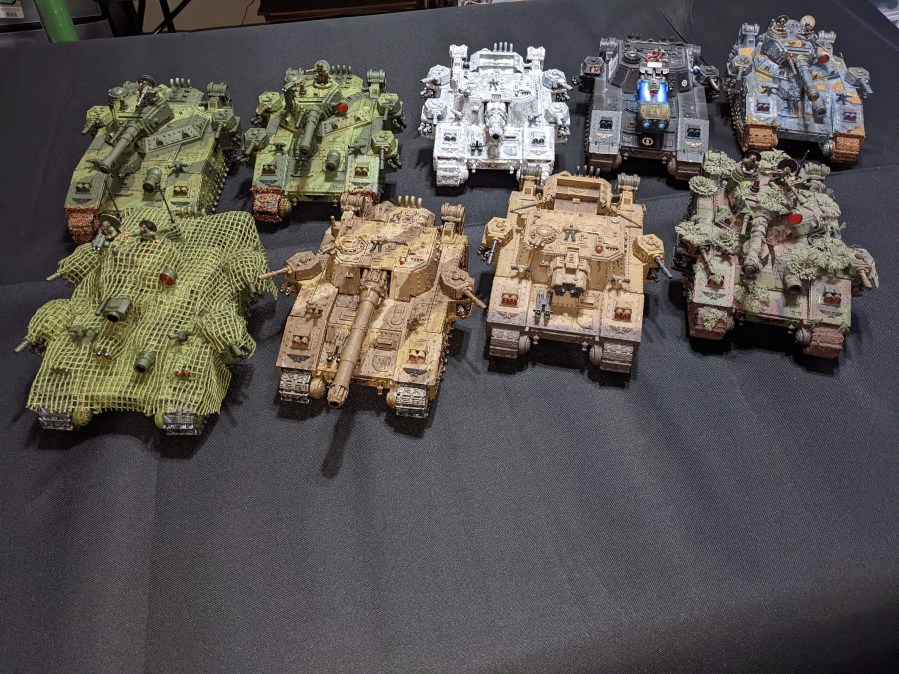
The Covenant had a surprisingly well rounded space and ground list. They did not have the best shoulder fired anti tank weaponry, but had well rounded troops and vehicles to the point where it could be managed. This worked until they ran in to 5 of the 6 Land Raiders that had just blown their way through the Rebel Alliance, but they were able to tie them up for the remainder of the game.
The Flood was a difficult one to do. They started pretty basic, with a template option to infect enemy troop types before the battle. They had poor BS but good WS with a bonus to S, T, and Feel No Pain. Mass fire brought them down super easy, but if Infection Swarms were left untouched they could infect Open Topped Vehicles or large infantry formations. Their ships performed ramming manuevers to deliver massive amounts of boarding parties! Either it succeeded, failed, or succeeded to well and the reactor would explode. They were not reliable in massive games, but were tons of fun to play. Best moment was when a Borg infected Stormtrooper got infected by an Infection form. A very confused and enhanced trooper indeed!
Back to the important bits though. We wanted to ground the Alternate Rules in the stability of 6th and 7th core rules. End of 7th was not great, so most of that material was tossed out. It was the beginning of the end and had the quality control of 8th and 9th edition, so we did not want that. The point formula was adjusted to include some 9th aspects and math hammered for a further 120 hours. Minor adjustments were made after that, but only three or four on the extreme ends of the spectrum.
Next, we launched the original three pillar Codexes! Old school rough drafts. Very rough formats. Imperial Guard, Necrons, and Orks. Orks fell through and later saw a total reboot of the Codex. During the Rough Draft stages for 18 Codexes, we saw two additional formats come to light. If I remember right we finished that right about 1900 man hours invested.
Final Drafts land where we are now. 5 Codexes done, with three Supplements available on the website after testing. We are pending Black Templars next! This part of the work is recorded in our Narrative and Video Battle Reports for those of you who are interested.
Mostly lots of boring paper work, testing, finding out it does not work, retesting, etc until the unit is acceptable. Then making the next one, finding the 354th unit is not compatible with the 3rd and reworking and retesting all over again. Finding time for paperwork is the hardest part!
We appreciate your interest and always look forward to hearing from you!
 Alternate 40k Rules